Best Emergency Weather Radios in 2026: NOAA Crank and Solar Picks
Seven receivers checked against NWS documentation and the makers' pages, from a crank radio to a county-alert desk unit.
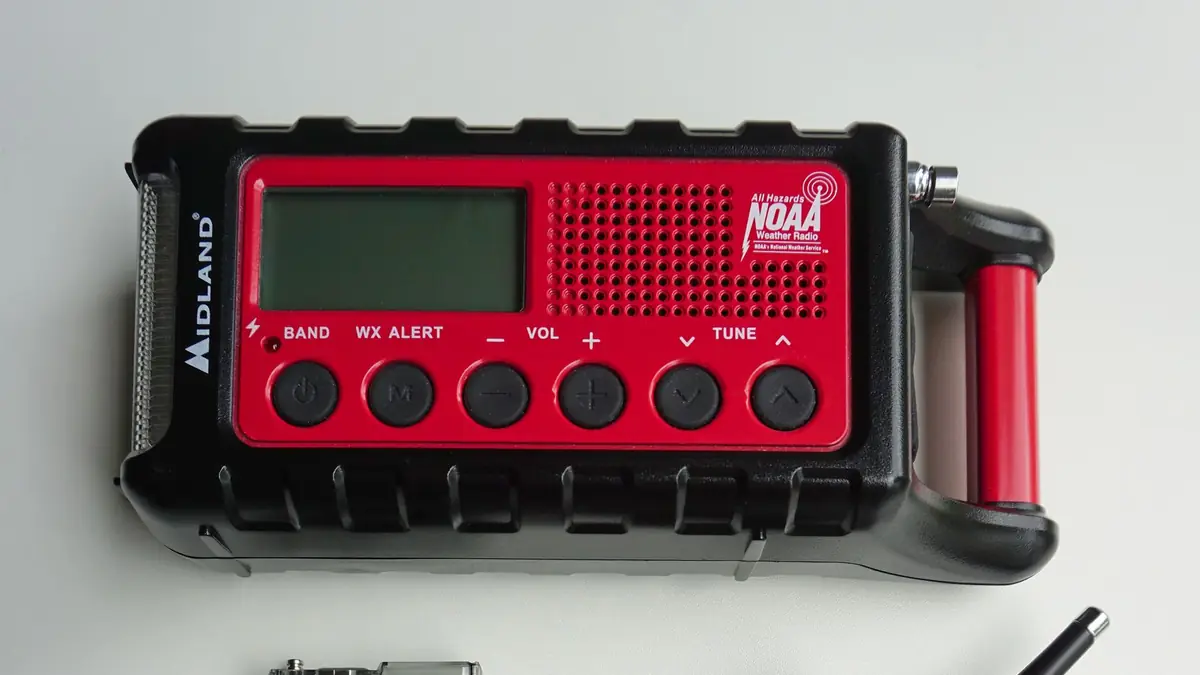
Get the Midland ER310 if you want one crank and solar weather radio that does the job and has its power rules written down by the maker. If you want a weather radio that also works as a 10,000 mAh power bank, take the Midland ER310PRO. If you want the radio to wake you at 3 a.m. for your county only, the Midland WR120B (a SAME desk radio) is the right tool, and it belongs next to the crank radio, not instead of it. For long-distance AM, FM and shortwave listening on two AA batteries, the C. Crane Skywave 2. For a crank radio you will use as a normal radio, with Bluetooth for streaming from a phone, the C. Crane CCRadio Solar. These are receivers only. You cannot talk back on any of them.
What NOAA Weather Radio actually is
NOAA Weather Radio All Hazards is a nationwide network of more than 1,000 transmitters run by the National Weather Service, broadcasting around the clock on seven VHF frequencies from 162.400 to 162.550 MHz. It carries forecasts, watches and warnings, and non-weather alerts such as AMBER alerts and 911 outages, per weather.gov/nwr. It works with the Emergency Alert System. You need a receiver to hear it; a phone generally cannot pick it up, and it does not need cell service or internet.
The NWS says a transmitter typically reaches about 40 miles on level ground, and hills and mountains cut that. That matters in western North Carolina. Its coverage maps assume ideal conditions, and actual coverage may be 5 to 10 percent below the prediction. Look up the station for your county on the NWS station listing before you decide where in the house the radio will live.
SAME: the feature that decides how annoying the radio is
SAME stands for Specific Area Message Encoding. It is the short digital burst at the start of an alert that says what the alert is, which area it covers (usually by county) and when it expires. A SAME receiver lets you enter your county code, so it stays quiet for warnings in the other counties the transmitter covers, which can be 5 to 10 counties' worth. A tone-activated radio goes off for all of them, per the NWS. After the burst comes a 10-second, 1050 Hz tone.
Midland's page for the WR120B lists S.A.M.E. with 25 programmable locations. Midland's pages for the other Midland radios here do not mention SAME, nor do the Sangean or C. Crane pages, so assume they sound for every alert on their channel (Midland says outright that the ER310's alerts cannot be customized). If you live where several counties share a transmitter, that is a good reason to own a SAME desk radio too.
Crank power is the last resort
Every crank radio here runs on a rechargeable battery that you can top up from USB, solar or the crank. The order matters. USB from a power bank or a wall charger before the storm is the fast way. Alkaline AA batteries in the pantry are the plain way, and several of these radios take them. The crank is what you do when all of that is gone.
Midland is candid about this. Its ER310 guide says one minute of cranking gives short-term radio and light use, and the product page says solar extends the charge of a full battery but does not charge a dead one. The product page also says the radio may not charge newer phones or tablets, and the guide says it suspends radio functions while charging an external device. So treat the crank as a way to get a few minutes of weather information, not a phone charger. For phone power, see our solar power bank guide.
What to check instead: battery type (a removable or AA-fed radio survives a dead cell), USB charging in, a headphone jack (saves battery at night), AM/FM for local news, and a flashlight that is usable and not a gimmick. Our power outage kit checklist lists the radio next to the spare batteries it needs.
Midland ER310

Best Overall
Midland ER310
- Rechargeable Li-ion battery, 6 AA backup
- Charges by micro-USB, solar or crank
- 7 NOAA channels, 162.400 to 162.550 MHz
- USB out 5V/2.1A
- Cree LED flashlight with SOS
For a household that wants one weather radio with honest power instructions.
Check price on AmazonSold by Midland Radio
The ER310 runs on a built-in 3.7 V lithium-ion battery that charges by micro-USB, solar or hand crank, and takes six AA batteries as a backup (not rechargeable by the radio), selected with a switch. It receives AM, FM and the seven NOAA channels (162.400 to 162.550 MHz), and in alert mode it sits in standby listening for a warning. There is a Cree LED flashlight with low, high and SOS settings, and a dog-whistle tone. The USB out port is 5V/2.1A maximum, per Midland's guide. It measures 8.0 by 3.4 by 2.4 inches. Sold on Amazon by Midland Radio.
The weak points: the radio stays on around the clock and only fully powers off if you pull the battery, per Midland. The solar panel only tops up a charged battery, and there is no SAME. It is still the radio we would buy first, because the maker tells you plainly what it will and won't do.
Midland ER310PRO
Best With Power Bank
Midland ER310PRO
- 10,000 mAh Li-ion, 200+ hours of radio use
- USB-A out 5V/2.1A
- USB-C, solar or crank charging
- Bluetooth streaming
- 7 NOAA channels with alert
For someone who wants the radio and a phone-sized power reserve in one body.
Check price on AmazonSold by Midland Radio
The ER310PRO is the same idea with a bigger battery. Midland's page lists a replaceable 3.7 V, 10,000 mAh lithium-ion pack, "200+ hours" of radio operation, solar and hand crank charging, USB-C charging (6 to 8 hours for a full charge from a 5 V source), a USB-A out port at 5V/2.1A for phones, Bluetooth streaming, and NOAA reception on 7 channels with an alert function that wakes the radio from standby. Sold on Amazon by Midland Radio.
Midland says a full battery can charge most smartphones up to three times, and that the radio should be at least 50 percent charged before you use the USB out port. Its limits are the crank and panel: Midland says the panel only gives a trickle charge in direct sun and describes the crank as maintenance charging, though another line on the same page claims 10 to 20 minutes of radio per minute of cranking. Charge it by USB before the storm.
Midland ER40
Compact Pick
Midland ER40
- 2600 mAh Li-ion, replaceable
- Hand crank, solar and micro-USB charging
- 7 NOAA channels
- LED flashlight with SOS strobe
- AM, FM and clock
For a glovebox, a kid's bag or a second radio.
Check price on AmazonSold by Midland Radio
The ER40 is the smaller, simpler crank radio. Midland's page lists a replaceable 2600 mAh lithium-ion battery, AM and FM with a clock, solar and hand crank charging, micro-USB charging, an LED flashlight with an SOS strobe, and a USB port on the side for charging phones. Its guide lists the seven NOAA channels. Midland gives no output rating for the USB port and no dimensions or weight, so check the box if those matter. Sold on Amazon by Midland Radio.
One difference from the ER310: the guide says not to use alkaline or other standard batteries, so there is no AA backup. It is a candidate for a glovebox or a kid's go bag. For the house, we would pick the ER310 over it because the ER310 takes AA cells when the battery is dead.
C. Crane CCRadio Solar
Best for Everyday Listening
C. Crane CCRadio Solar with Bluetooth
- 3400 mAh Li-ion (18650), 3 AA backup
- Charges by crank, solar or USB
- AM, FM and NOAA channels 1 to 7 with alert
- More than 50 hours on a full charge
- 6 x 3 x 2.25 in, about 1.1 lb
For a household that will actually listen to AM and FM every day and wants the crank and solar as backup.
Check price on AmazonSold by C. Crane
C. Crane describes the CCRadio Solar as a small digital radio for emergencies that is also meant for daily use, such as the morning news by a sunny window. This is the Bluetooth version. Its included battery is a 3.7 V, 3400 mAh lithium-ion cell (18650 size), and C. Crane says a full charge runs the radio for more than 50 hours, depending on volume and power mode. It also takes three AA alkaline batteries (not included), about 50 hours in low-power mode and 35 in high-power mode. C. Crane warns against lithium AAs, which can read above 1.6 volts fresh and damage the radio.
It receives AM (520 to 1710 kHz), FM (87.5 to 108 MHz, or 76 to 108 MHz expanded) and NOAA channels 1 to 7. C. Crane lists five memory presets per band, a lighted display, a clock, alarm and sleep timer, a headphone jack and a line-in jack. The speaker is tuned for voice, with a low-power mode to stretch the battery. Bluetooth receiving streams audio from a phone or tablet to the radio's speaker. Sold on Amazon by C. Crane.
The weather alert is a watch mode, not SAME. You tune to your local NOAA station, then choose 4, 8 or 16 hours or on, and the radio beeps continuously for two minutes when an alert is issued. AM and FM stay usable while it watches, and the display light flashes every few seconds as a reminder. C.
Charging is where to keep expectations low, and C. Crane gives the numbers. From a battery at one bar, it lists about 10 to 12 hours of cranking (the crank is rated 300 to 500 mA at about two turns per second), about 42 hours in full sun on the panel, and up to 9 hours by USB, the fastest method. So charge it by USB before the storm and treat the crank as the backup. A full battery can bring a phone from about 50 percent to 100 percent through the USB out port. It weighs about 1.1 pounds.
How it differs from the Skywave 2: the Skywave 2 is a better receiver on AA batteries, with shortwave and no crank. The CCRadio Solar gives up shortwave for a crank, a panel and a phone port, so it is the one to leave on the kitchen counter and still trust when the lights go out.
Sangean MMR-88
Compact With Display
Sangean MMR-88
- 850 mAh Li-ion, 14 hours of play
- Solar, crank or micro-USB charging
- AM, FM and all 7 NOAA channels
- Triple LED flashlight with SOS
- 5.99 x 3.34 x 2.72 in, 0.83 lb
For someone who wants a compact radio with a backlit display and station presets.
Check price on AmazonSold by Sangean America, Inc.
The MMR-88 is a small multi-powered radio from Sangean, a long-running radio maker. Sangean's page lists an 850 mAh rechargeable lithium battery rated for 14 hours of play, charging by solar panel, dynamo hand crank or micro-USB (5V/0.5A in), an AM, FM and weather tuner with all seven NOAA frequencies, 19 station presets, a backlit LCD, and a triple-LED flashlight with low, high, blinking and SOS modes. It measures 5.99 by 3.34 by 2.72 inches and weighs 0.83 pounds. Sold on Amazon by Sangean America, Inc.
The limits are on the same page: the USB output is 5V/0.3A, so it is a token phone top-up and not a charger, and the battery is the smallest in this group. Pick it if you want a compact radio with a screen and presets and you will keep a power bank or batteries for everything else.
C. Crane CC Skywave 2
Best Reception
C. Crane CC Skywave 2
- AM, FM, shortwave 2300 to 26100 kHz, NOAA, VHF air
- 400 memories
- About 60 hours on 2 AA, speaker
- 6.0 oz without batteries
For long listening on AA batteries with a receiver better than any crank radio.
Check price on AmazonSold by C. Crane
This one has no crank and no solar panel on purpose. It is a pocket receiver for AM, FM, shortwave (2300 to 26100 kHz), the seven NOAA weather channels with an alert function, and VHF aviation (118 to 137 MHz), with 400 memories, direct frequency entry and multiple bandwidth settings. It runs on two AA batteries for roughly 60 hours on the speaker (70 on earbuds), per C. Crane, and weighs 6.0 ounces without batteries. C. Crane's weather alert watches for 4, 8 or 16 hours and beeps for two minutes when NOAA issues an alert. Sold on Amazon by C. Crane.
Why include it: the receiver is the point, with digital tuning and a 19 inch whip antenna, per C. Crane. The cost is that it relies on AAs, so store a dozen. C. Choose this if you will listen to news for days, not if you want a flashlight and a crank.
Midland WR120B
Best for County Alerts
Midland WR120B
- S.A.M.E. programming
- 25 programmable locations
- 3 AA backup, AC adapter included
- Over 60 alert types
- Color-coded alert indicators
For the bedroom, where it wakes you for your county only.
Check price on AmazonSold by Midland Radio
The WR120B is a plug-in desk alert radio. Midland's page lists S.A.M.E. programming with 25 programmable locations, color-coded alert level indicators, alert override, a 90 dB siren, and over 60 emergency alert types (elsewhere the same page says 85+). Power is an included AC adapter, with three AA alkaline batteries as backup (not included). Sold on Amazon by Midland Radio.
This is the one that wakes you up. Midland says tornado and hurricane warnings stay on and cannot be disabled, and you can switch other alert types on or off. It is not portable the way the others are, so put fresh AAs in it, put it in the bedroom, program your county, and keep the crank radio in the kit for when the power is out.
Side by side
| Radio | Power | Bands | USB out | County filter (SAME) | Best for |
|---|---|---|---|---|---|
| Midland ER310 | Li-ion, crank, solar, USB, 6 AA | AM, FM, 7 NOAA | 5V/2.1A | Not stated | First crank radio |
| Midland ER310PRO | Crank, solar, USB-C, 10,000 mAh | AM, FM, 7 NOAA | 5V/2.1A | Not stated | Radio plus power reserve |
| Midland ER40 | 2600 mAh, crank, solar, micro-USB | AM, FM, 7 NOAA | Yes, rating not given | Not stated | Small kit radio |
| C. Crane CCRadio Solar | Li-ion, crank, solar, USB, 3 AA | AM, FM, 7 NOAA | Yes, rating not given | Not stated | Everyday listening |
| Sangean MMR-88 | 850 mAh, crank, solar, micro-USB | AM, FM, 7 NOAA | 5V/0.3A | Not stated | Small radio with display and presets |
| C. Crane Skywave 2 | 2 AA | AM, FM, SW, 7 NOAA, VHF air | None | Not stated | Best reception |
| Midland WR120B | AC adapter, 3 AA backup | NOAA | None | Yes, 25 locations | Bedside county alerts |
What we left out, and who should skip this
We left out the Eton FRX3, which was nearly out of stock on Amazon, and the Sangean MMR-99, the bigger Bluetooth sibling of the MMR-88, which was sold only by a third-party seller. We also left out the dozens of unbranded 10,000 and 12,000 mAh crank radios with no maker page, where the battery figure is the only claim.
These are receivers. If you need to talk to someone, that is a different radio: see our GMRS guide for voice with a license, or our Meshtastic guide for text over a mesh with no license. For the full storm list including a radio, read the North Carolina hurricane kit and browse the other off-grid comms guides.
Skip the crank radio entirely if you will always have a phone with a charged bank and a good signal. A weather radio only matters if you will be somewhere without both.
Questions people ask
Do I need a license to use a weather radio?
No. NOAA Weather Radio is a one-way broadcast and these are receivers only.
Will a weather radio work without power?
Yes, on batteries, and on solar or crank for a short time. The crank gives a few minutes, so keep fresh AAs or a charged USB bank as the plan.
What is the difference between SAME and a tone alert radio?
A SAME radio can be set to your county and ignores alerts for the other counties on the same transmitter. A tone-activated radio sounds for every alert it hears, per the NWS.
Can a crank radio charge my phone?
Barely. Midland says the ER310 may not charge newer phones or tablets, so use a power bank for that.
Where do I find my county's SAME code and station?
The NWS publishes a station listing and county listing at weather.gov/nwr, and the radios walk you through entering the code.
The pick
Buy the Midland ER310 for the kit and the Midland WR120B for the bedroom, and keep spare AA batteries for both.
Sources
- NWS: NOAA Weather Radio All Hazards
- NWS: NWR alerts, SAME and receivers
- NWS: NWR coverage maps and station links
- Midland ER310 full user guide
- Midland ER310 product page
- Midland ER310PRO product page
- Midland ER40 product page
- Midland WR120B product page
- Sangean MMR-88 product page
- C. Crane CC Skywave 2 product page
- C. Crane CCRadio Solar Bluetooth product page
Ready to buy?
See current models and availability on Amazon. Your clicks keep these guides free.
Shop Emergency Weather Radios on Amazon →