Best Solar Power Banks and Folding Panels for a Power Outage in 2026
Four picks checked against the makers' specs and the FAA's battery rules, with the honest numbers on solar charging.
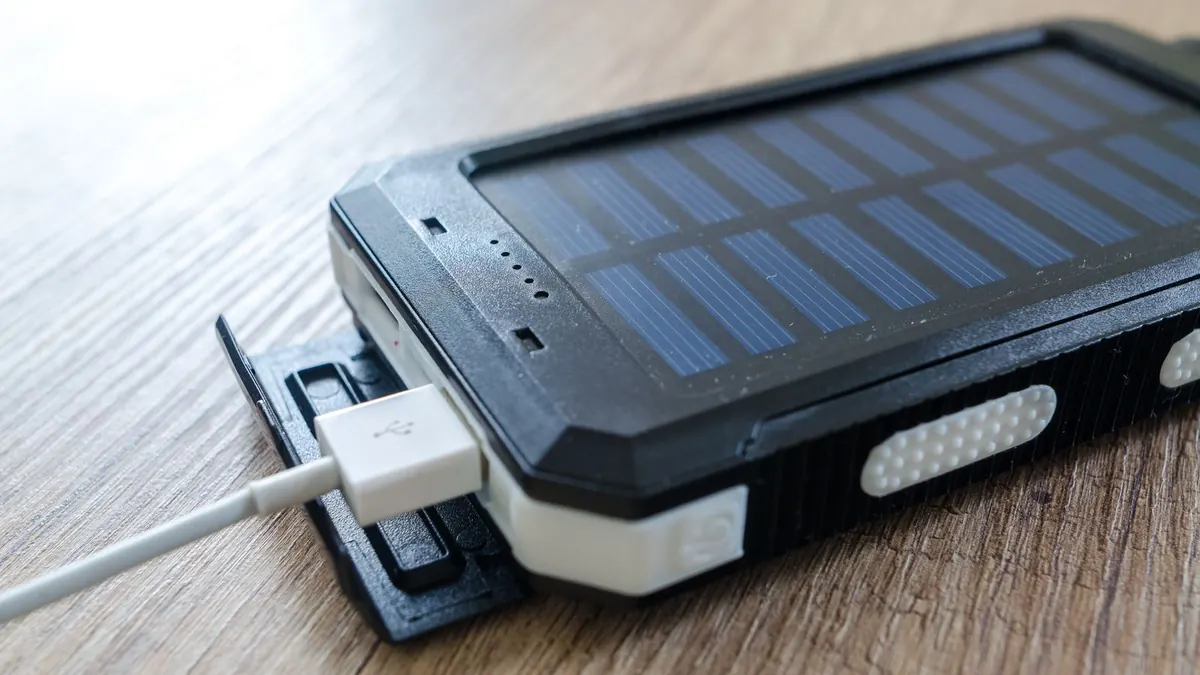
The honest answer first: the solar panel built into a pocket power bank is too small to count on. Buy a normal 20,000 mAh bank and charge it from the wall before the storm, then add a separate folding panel if you want to top it up in daylight. For the bank, the Anker 20K 87W is the all-rounder and the Anker Zolo 45W is the lighter pick. For the panel, the BigBlue 35W is the one for a household that wants real recharging, and the Goal Zero Nomad 5 is the small, rugged option for phone and headlamp top-ups.
Why the panel on a solar power bank disappoints
Solar output depends on panel area and direct sun. A bank has a panel the size of one face of the case, a few square inches, and it sits flat in a window or on a dashboard at the wrong angle most of the day. Even in good sun it adds a trickle. Meanwhile the battery it is trying to fill holds a lot of energy. A 20,000 mAh bank stores roughly 72 Wh (20 Ah times the usual 3.6 V cell rating; Anker lists mAh, not Wh). Filling that from a pocket-size panel takes days of clear sun, and there is no way to aim it.
Banks with a built-in panel rarely state how many watts that panel produces, only the battery size and the wired charging speed. Anker's banks have no panel at all. Treat the panel as an emergency top-up for a phone that is at 3 percent, not as your power plan. The solar claim is the weakest part of these products; the battery, cables and flashlight are the useful parts.
A separate folding panel works better because it is bigger and you can angle it at the sun while the battery sits in the shade. A 20 to 35 W panel and a plain 20,000 mAh bank is the setup that fills a phone in an afternoon. Even that is weather dependent. In a hurricane the sky is the problem, and after an ice storm the days are short, which is one reason the bank should be full before the weather arrives. Our power outage kit checklist puts the charged bank in the kit for that reason.
What to look at when you buy
mAh versus Wh
mAh is only meaningful at a stated voltage. Watt-hours (Wh) is the number to compare: multiply volts by amp-hours, which is also how the FAA tells you to calculate it. Banks of the same mAh can hold slightly different energy, and what you get out is less than what is printed because of conversion losses. Anker's page for the Zolo 20,000 mAh bank says about 4 full charges for an iPhone 16, which is a more useful way to read capacity than the raw number. Goal Zero's Flip 24 page gives both figures for its bank: 6,700 mAh at 3.6 V is 24.12 Wh.
USB-C PD watts
Power Delivery watts decide how fast the bank charges a phone and whether it can run a tablet or small laptop. The Anker 87W model shares 87 W across three ports with up to 65 W to a single device; the Zolo tops out at 45 W from a single port and shares 15 W when several ports are in use, per Anker's page. A phone does not need more than 20 to 25 W, so the extra headroom matters for tablets and laptops and for recharging the bank itself quickly from a generator or wall charger. Anker's page says the 87W bank recharges in about 1.5 hours on a 65 W charger.
Pass-through
Pass-through means charging a phone from the bank while the bank is itself charging. Many banks do it, some switch the output off and on, and makers rarely promise it. Goal Zero lists pass-through as supported on the Flip 24; Anker's pages for the two banks here do not mention it. Test your own bank before you depend on it, and if you do depend on it, charge the bank from the panel first and the phone second.
Panel rating versus what comes out of the port
A "35W" panel is a peak rating in ideal sun. BigBlue's own FAQ says the actual output is less than the rated power, because of heat loss in conversion, weather and season. The ports are a second limit: on the P35 only USB-C1 does PD 25 W, and the total across all ports tops out at 35 W. Cloud, haze or the wrong angle cut it further. The panel does not store energy; it only works while lit, so plug it into a bank rather than directly into a phone you want protected from the panel stopping and starting.
Flying with a power bank
The FAA says spare lithium batteries and power banks go in carry-on only, and batteries up to 100 Wh need no airline approval; 101 to 160 Wh need approval, and airlines can set stricter limits.
For anything bigger than a bank, meaning a battery that runs a fridge, a CPAP or a window unit, see our sister site's battery backup versus gas generator guide. A phone-size bank will not do that job.
Anker 20K 87W Power Bank

Best Power Bank
Anker 20K 87W Power Bank
- 20,000 mAh
- 87 W total, 65 W to one device
- Built-in USB-C cable
- 15.5 oz, 18-month warranty
- Airline approved
For a household that wants one bank for phones, a tablet and a radio.
Check price on AmazonSold by AnkerDirect
This is the bank we would put in a kit. Anker lists 20,000 mAh, a built-in USB-C cable, three ports and 87 W total output, 65 W to one device, and says the built-in cable takes an iPhone 15 Pro to 58 percent in 30 minutes. The page calls it approved for airline travel, gives 6.2 by 2.89 by 1.02 inches and 15.5 ounces, and lists an 18-month warranty. Anker's Canadian page also prints 10,000mAh in its spec table against 20,000 mAh everywhere else in the description. Sold on Amazon by AnkerDirect.
What it does badly: it has no solar panel at all, so you need a separate panel to recharge it off-grid, and the built-in cable is a single point of failure if it frays (bring a spare USB-C cable). It is heavy for a pocket. For a household that wants one bank for phones, a tablet and a radio, it is the default.
Anker Zolo 20K 45W Power Bank
Lighter Bank
Anker Zolo 20K 45W Power Bank
- 20,000 mAh
- 45 W from one port, 15 W shared when several are in use
- Two built-in USB-C cables plus USB-C and USB-A ports
- 12.85 oz, 18-month warranty
- About 4 iPhone 16 charges
For people who mostly charge phones and small gear and want less weight.
Check price on AmazonSold by AnkerDirect
Same 20,000 mAh capacity in a lighter case at 12.85 ounces, with dual built-in USB-C cables plus a USB-C port and a USB-A port, so it connects up to four things at once (but they share only 15 W). Anker's page says it delivers about four full charges for an iPhone 16 and gives 45 W from the built-in cable or USB-C port alone, with the USB-A port up to 22.5 W and 15 W shared when several ports are used. Anker also says the USB-C port and built-in cables support 40 W fast charging for iPhone 17 series phones. Sold on Amazon by AnkerDirect.
Its limits are the 45 W ceiling and the shared 15 W when several ports are in use, which is plenty for phones and tablets but slow for a laptop, and again no solar panel. The second built-in cable helps with the single-cable failure problem. If you mostly carry phones and a GPS or a hand radio, take this one and save the weight.
BigBlue 35W Solar Charger
Best Folding Panel
BigBlue 35W Solar Charger
- 35 W rated, 1.54 lb
- USB-C1 PD 25 W with PPS, 35 W combined max
- 1 USB-A and 2 USB-C ports
- Panel rated IP68 (junction box not waterproof)
- Folds to 8.29 x 4.84 x 1.89 in
For anyone who wants to refill a power bank in daylight during a multi-day outage.
Check price on AmazonSold by BigBlue-US
This is the panel we would pair with either bank. BigBlue's page for the SolarPowa P35 lists one USB-A port and two USB-C ports, PD 25 W with PPS on USB-C1, up to 35 W combined, monocrystalline back contact cells with up to 25.4 percent efficiency, an IP68 panel, a folded size of 8.29 by 4.84 by 1.89 inches and a weight of 1.54 pounds. It unfolds to 23.74 by 16.57 inches. Sold on Amazon by BigBlue-US.
Honest limits: BigBlue says the IP68 rating covers the panel only and not the junction box, so keep that part dry. The panel does not store power, so it only produces while it is lit; aim it at the sun and check the angle every hour or so. Hang it from a pack, a porch rail or a car mirror, and plug a bank into it rather than a phone you want protected from the panel stopping and starting.
Goal Zero Nomad 5 with a Flip power bank
Rugged Mini Panel
Goal Zero Nomad 5 Solar Panel
- 5 W, 5V/1A USB output
- 12.7 oz
- Built-in dock for a Flip power bank
- Kickstand, 2-year warranty
- Flip 24 is 6,700 mAh / 24.12 Wh, per Goal Zero
For small top-ups of a phone or headlamp from a rugged, simple panel.
Check price on AmazonSold by Goal Zero LLC
Goal Zero is the maker most associated with this idea, and its own numbers show the scale. The Nomad 5 is a 5 W panel (5V/1A output) that weighs 12.7 ounces, with a built-in kickstand and a dock that holds a Goal Zero Flip bank. The Flip 24 holds 6,700 mAh (24.12 Wh) and outputs 5V at up to 2.1 A, per Goal Zero's pages. Sold on Amazon by Goal Zero LLC.
The arithmetic is plain: 24.12 Wh divided by a 5 W panel is about 4.8 hours at the rated maximum with perfect sun, which real conditions rarely give. That is fine for a phone and a headlamp, and it is a clean, rugged system with a two-year warranty. It is not a household plan. The Flip bank is sold separately, so check what you are buying; the panel alone includes no battery.
Side by side
| Product | Type | Key spec | Solar input | Best for |
|---|---|---|---|---|
| Anker 20K 87W | Power bank | 20,000 mAh, 87 W total, 65 W single port | None | Main bank for phones, tablets, radios |
| Anker Zolo 20K 45W | Power bank | 20,000 mAh, 45 W, two built-in USB-C cables | None | Lighter bank for phones and small gear |
| BigBlue 35W | Folding panel | PD 25 W USB-C, 35 W combined, IP68 panel | 35 W peak rating | Home or camp recharging of a bank |
| Goal Zero Nomad 5 | Folding panel | 5 W, 5V/1A, Flip dock | 5 W | Phone and headlamp top-ups |
What we left out, and who should skip this
We left out all-in-one solar power banks with a built-in panel for the reasons above: the panel is a small trickle charger and the useful parts are the battery, cables and flashlight. A pocket-size folding panel is a reasonable add for a go bag, but it is slower than a full-size folding panel such as the BigBlue 35W. We also left out the 48,000 mAh and 80,000 mAh "solar" banks, where the extra capacity makes the little panel even less relevant. We also skipped Jackery, EcoFlow and Goal Zero's larger panels, which are built for power stations through XT60 or Anderson connectors and not for phones; if you own one of those stations, our sister site covers the larger generators and stations.
Skip a solar bank if your outage plan is a generator or a car charger. A car charger and a short cable will almost certainly beat a pocket panel, as long as you have fuel and the car is parked outside. If light is your main need rather than power, our best lantern for a power outage guide is the better read. If you run a mesh node on solar, that is a different build, covered in our Meshtastic solar node article. The rest of the power and light guides cover lanterns and kits.
Questions people ask
Can a solar power bank charge a phone fully?
Not reliably. The built-in panel is too small to count on, so charge the bank at home. A separate folding panel plugged into a normal bank does the job, given a few hours of direct sun.
How many phone charges is 20,000 mAh?
Anker's page for the Zolo says about four full iPhone 16 charges. Expect fewer on phones with bigger batteries, and a little less than the label because of conversion losses.
Can I bring a power bank on a plane?
Yes, in carry-on only. The FAA allows batteries up to 100 Wh without airline approval. A 20,000 mAh bank is about 72 Wh, so it is under that, but your airline may set its own limits.
Does a panel work through a window or under clouds?
It works poorly in both. BigBlue says to place its panel in direct sunlight and aim it at the sun, and glass and cloud cut the output further. Put the panel outside, aimed at the sun.
What should I use for a bigger battery?
A power station, not a power bank. See our battery backup versus gas generator comparison first.
The pick
Buy the Anker 20K 87W, charge it before the storm, and add the BigBlue 35W if you want to refill it in daylight; ignore the solar panel on any bank that has one.
Sources
Ready to buy?
See current models and availability on Amazon. Your clicks keep these guides free.
Shop Power Banks and Solar Panels on Amazon →