Best Long Range Walkie Talkies: What Actually Reaches, and What the Box Means
Seven radios from license-free FRS to repeater-capable GMRS, with the makers' own range numbers instead of the ones on the box.
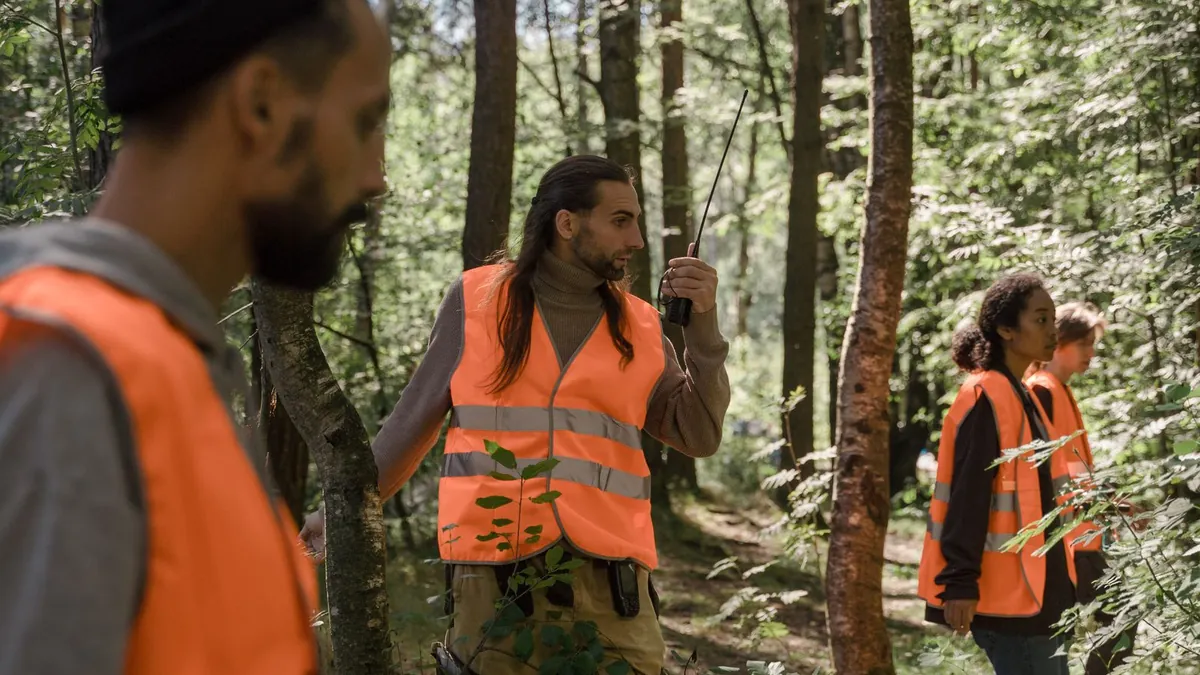
The longest-range walkie talkie you can buy without a license is a 2 watt FRS radio, and the honest number for that around houses and trees is one to two miles. The Rocky Talkie Mountain Radio is the best built of those, the Motorola Talkabout T470 is the easiest to find and use, and the Midland T71VP3 is the one with AA backup for a long outage. If you want more, you need GMRS, which takes a license but no test: the Midland GXT1000 is the step-up pair, and the Midland GXT67 Pro and Rocky Talkie 5 Watt are 5 watt, repeater-capable handhelds that can reach 20 or 30 miles through a repeater. The 35 or 40 mile number on every box is a mountaintop-to-mountaintop figure, and nothing in this guide changes that physics.
Why the box is lying to you (sort of)
Midland's own FAQ for the GXT1000 says the 36 mile claim is for "perfect conditions such as mountain top to mountain top" and that the radio "averages 1/2 to 2 miles in normal conditions." Motorola's T470 data sheet says the advertised range is calculated "under optimal conditions, with a clear line of sight." Rocky Talkie publishes a terrain table for its FRS radio: 35 miles line of sight, 1 to 5 miles in mountains, half a mile to 3 miles in forest and hills, up to a mile in a city. None of these companies is lying. They are quoting the best case and hoping you don't read the footnote.
These radios all run UHF, 462 and 467 MHz. UHF goes where you can see, plus a bit. It does not bend over a ridge. It gets eaten by wet leaves. In the Piedmont, two people on FRS radios in a subdivision will usually talk across the neighborhood and lose each other somewhere past the second hill. On a beach at Topsail with nothing in the way, you'll do a lot better. In a cove in Madison County, you may not reach the next house.
What actually sets range, in order of how much it matters:
- Terrain and obstructions. Hills, buildings, trees. Nothing beats a clear path.
- Antenna height. Standing on a porch roof beats standing in the yard. A car roof antenna beats a handheld.
- Antenna quality. FRS antennas are fixed by law and short. GMRS handhelds can swap to a longer one.
- Power. 2 W versus 5 W is a modest edge, not a doubling. 50 W in a vehicle is a real step, mostly because of the antenna that comes with it.
- A repeater. The only thing that makes a handheld reach 20 miles. GMRS only.
Two kinds of radio, one set of channels
FRS and GMRS share the same 22 channels, so any radio here will talk to any other. FRS radios are license-free, capped at 2 watts with a fixed antenna, and cannot use repeaters. GMRS radios need an FCC license (no exam, ten years, covers the family), run 5 watts in a handheld and up to 50 watts in a mobile on the main channels, and can use repeaters. The full breakdown is in our GMRS vs FRS comparison. The practical version for this guide: if the longest distance you need is across a campground or a few blocks, FRS. If it is across a county, GMRS, and probably a GMRS mobile or a repeater rather than a handheld.
What to check before buying
- FRS or GMRS. Decide whether you will get the license. If not, buy FRS and stop reading the GMRS section.
- Battery, and what happens when it dies. Lithium packs last days; NiMH packs last hours. Radios that also take AA alkalines (T71, GXT1000, T470) keep working on day five of an outage when nothing is charging.
- Weather rating. IP67 means it survives a dunk. IPX4 or JIS4 means rain and splashes. In a hurricane, that difference matters.
- NOAA weather. Most of these receive NOAA weather radio with alerts. That is a feature you will use more than the range.
- Repeater channels. On GMRS only. If the radio does not list "repeater capable" or 8 repeater channels, it is simplex only.
Rocky Talkie Mountain Radio

Toughest FRS
Rocky Talkie Mountain Radio
- 2 W FRS, license free
- 1550 mAh replaceable battery, 3 to 5 days
- IP56 splash and snow proof
- 6.1 oz
- 128 channels, per the listing
For kids' packs, kayaks and anyone who breaks ordinary walkie talkies.
Check price on AmazonSold by Rocky Talkie
This is the FRS radio for people who are hard on gear. 2 watts, which is the FRS legal maximum, a replaceable 1550 mAh lithium battery that Rocky Talkie rates at 3 to 5 days, a shatterproof screen, a thermoplastic shell, and a carabiner-style clip with a backup leash instead of a plastic belt clip that snaps off. It weighs 6.1 ounces and is IP56, which means splash and snow proof, not submersible. It has 128 channels (the 22 FRS channels with preset privacy codes) and five buttons. Rocky Talkie says 1 to 5 miles is typical in backcountry terrain, and that matches what FRS does.
What it lacks: no NOAA weather receive, a real gap for storm use, and no AA fallback. It is also the expensive end of FRS. On a kid's pack or a kayak deck, the build justifies it; in a kitchen drawer for outages, the Midland below is the better value. Sold on Amazon by Rocky Talkie, two-pack.
Motorola Talkabout T470
Easiest FRS
Motorola Talkabout T470
- 22 FRS channels, 121 privacy codes
- IPX4 splash rating
- 7 NOAA channels with alerts
- 800 mAh NiMH or 3 AA; up to 12 / 28 hours
- Built-in flashlight, per the listing
For a family that wants a simple pair with weather alerts and easy returns.
Check price on AmazonSold by Amazon.com
The T470 is the FRS radio you'll find in every big box store, and it is sold on Amazon by Amazon.com. 22 channels, 121 privacy codes, IPX4 splash rating, 7 NOAA weather channels with alerts, a built-in LED flashlight, and an emergency button that sounds an alarm and opens the mic hands-free. It runs on an 800 mAh NiMH pack or 3 AA alkalines; Motorola's data sheet rates it at up to 12 hours on NiMH and up to 28 hours on alkalines, both at a 5/5/90 duty cycle. The radio weighs about 0.3 pounds without batteries.
The 35 mile claim is the usual line-of-sight number. NiMH packs fade after a year or two, so plan on AAs eventually. The plastic is ordinary consumer grade. It is still a sensible family pair: easy pairing, big buttons, and weather alerts that come through while it charges. Sold by Amazon.com, which means easy returns.
Midland T71VP3
Best FRS Value
Midland T71VP3
- 22 FRS channels plus 14 presets (36)
- 121 privacy codes
- Hi/Lo power
- NOAA weather alert with scan
- Runs on 3 AA alkalines, per the listing
For the outage drawer: cheap, license free, and AA powered.
Check price on AmazonSold by Midland Radio
Midland's T71 pair is the FRS radio with the most features for the money in this group: the 22 FRS channels plus 14 preset privacy code channels (36 total), 121 privacy codes, hi/lo power, NOAA weather alert with scan, silent operation, and eVOX hands-free. It charges over micro-USB in a desktop cradle. Midland's FAQ is unusually candid: the rechargeable packs run about 5 hours on high at a 90/5/5 cycle, and Midland suggests replacing them every 9 to 12 months. The radio also takes 3 AA alkalines, which is how you should run it in a multi-day outage.
The 38 mile range on the box is line of sight. There is no water rating listed, so keep it dry. For a drawer radio that you pull out when the power goes and hand to a neighbor, this is the pick, and it is sold on Amazon by Midland Radio.
Midland T290VP4
Light GMRS Pair
Midland T290VP4
- 22 GMRS channels plus 14 presets
- 121 privacy codes
- High, medium and low power
- NOAA weather scan and alert
- Headsets and desktop charger included, per the listing
For licensed users who want light, simple simplex radios for a crew.
Check price on AmazonSold by Midland Radio
The T290 is Midland's X-Talker line in a GMRS version, which means it needs the license but gives you high, medium and low power settings instead of FRS's 2 watt cap. It has the 22 channels plus 14 preset privacy code channels, 121 privacy codes, channel scan, NOAA weather scan and alert, eVOX, and a battery meter. It comes as a pair with headsets, a desktop charger and rechargeable packs. Midland claims up to 40 miles and, on the same page, says range "varies depending on obstruction and interference."
Midland does not publish the transmit wattage, and the T290 is not listed as repeater capable, so it is a simplex GMRS radio. That puts it in a narrow spot: more than FRS, less than the GXT1000 or GXT67 Pro. It is a good fit for someone who already has the license and wants light, simple radios for a work crew or a hunting party. Sold on Amazon by Midland Radio.
Midland GXT1000VP4
GMRS Starter
Midland GXT1000VP4
- 50 channels, 142 privacy codes
- JIS4 water resistant
- NOAA weather scan and alert
- NiMH packs or 4 AA alkalines
- SOS siren, per the listing
For the family with a GMRS license that does not need repeaters.
Check price on AmazonSold by Midland Radio
The GXT1000 is the best-known GMRS handheld there is. 50 channels, 142 privacy codes, JIS4 water resistance, SOS siren, NOAA weather scan and alert, 10 call alerts, and dual power from the included NiMH packs or 4 AA alkalines. It is the radio whose FAQ gave us the "1/2 to 2 miles in normal conditions" line, and that candor is part of why we trust the brand. It is not repeater capable and Midland does not publish the wattage. The pair ships with boom mic headsets, a desktop charger, and AC and DC adapters.
Where it fits: the family that has the GMRS license, wants two radios with real weather alerts and AA backup, and does not need repeaters. It is the sensible middle of this list, sold on Amazon by Midland Radio.
Rocky Talkie 5 Watt Radio
Best Range, Handheld
Rocky Talkie 5 Watt Radio
- 5 W GMRS, 8 repeater channels
- IP67, 1 meter submersion
- 1800 mAh replaceable battery, 4 to 6 days
- 9.1 oz
- Two antennas included, per the listing
For mountains, hunting camps and multi-day trips where range and battery both matter.
Check price on AmazonSold by Rocky Talkie
The GMRS version of the Mountain Radio, and the handheld in this guide with the most range potential for its size. 5 watts, IP67 waterproof to a meter, 8 repeater channels, NOAA weather with alerts, dual-channel monitoring, a replaceable 1800 mAh battery rated at 4 to 6 days, and two antennas in the box (a 7.5 cm stub and a 17 cm whip). It weighs 9.1 ounces. Rocky Talkie's own range table says 2 to 8 miles in mountains and 35 miles line of sight; through a repeater, the limit is the repeater's coverage, not the radio's.
It has only the 22 channels plus repeater pairs, no custom memories, and it is priced at the top of the handheld group. For a rescue squad, a hunting camp or a family that spends real time outside in the mountains, it is the one. Sold on Amazon by Rocky Talkie, two-pack.
Midland GXT67 Pro
Simplest Repeater Radio
Midland GXT67 Pro
- 5 W GMRS
- IP67 waterproof
- 8 repeater channels with split tones
- Up to 4 days battery, 4 hour charge
- DC vehicle charger included, per the listing
For the licensed user who wants a repeater-ready radio with nothing to program.
Check price on AmazonSold by Midland Radio
The GXT67 Pro is Midland's 5 watt, IP67, repeater-capable handheld with a backlit display and big buttons. 8 repeater channels with split tones, NOAA alerts, a battery rated at up to 4 days with a 4 hour rapid charge, and a DC vehicle charger in the box. Midland's range statement for it is "up to 5 miles, depending on the terrain," which is refreshingly modest. The battery is sealed and the antenna is fixed, and it is sold as a single radio. Pick it over the Rocky Talkie if you want the simplest path to a repeater and prefer Midland's layout. Sold on Amazon by Midland Radio. Our GMRS radio guide goes deeper on this radio and on the 50 watt mobiles that go in the truck.
The radios side by side
| Radio | Service | Power | Repeater | Water rating | AA backup | NOAA | Best for |
|---|---|---|---|---|---|---|---|
| Rocky Talkie Mountain Radio | FRS | 2 W | No | IP56 | No | No | Kids, kayaks, hard use |
| Motorola Talkabout T470 | FRS | Not published | No | IPX4 | 3 AA | 7 channels | Easy family pair |
| Midland T71VP3 | FRS | Not published | No | Not listed | 3 AA | Yes | Outage drawer radio |
| Midland T290VP4 | GMRS | Not published | No | Not listed | Not listed | Yes | Light simplex GMRS pair |
| Midland GXT1000VP4 | GMRS | Not published | No | JIS4 | 4 AA | Yes | GMRS starter pair |
| Rocky Talkie 5 Watt | GMRS | 5 W | Yes | IP67 | No | Yes | Mountains, multi-day trips |
| Midland GXT67 Pro | GMRS | 5 W | Yes | IP67 | No | Yes | Simplest repeater radio |
If you need to go farther than any of these
Handhelds top out. The way to actually reach across a county is a GMRS mobile radio in a vehicle or on a desk with a 12 volt supply, running 15 to 50 watts into an antenna on the roof or a mast, and a repeater. A 50 watt Midland MXT575 or BTECH GMRS-50V2 with a roof antenna will talk to a handheld far beyond where two handhelds would lose each other, and a repeater on a hilltop lets two handhelds 20 miles apart hold a conversation. Both options are covered in the GMRS guide. If what you need is short text and location across a neighborhood rather than voice, a LoRa mesh node does that with no license at all; see the rest of our off-grid comms guides.
What we left out
You will see BaoFeng UV-5R radios recommended as "long range walkie talkies" because they are cheap and put out more power than FRS. Do not buy one for this purpose. The UV-5R is an amateur radio transceiver, meant for the ham bands under FCC Part 97, which requires a Technician license earned by passing a 35 question exam (per the ARRL). It is not certified for FRS or GMRS, and transmitting on those channels with it is illegal regardless of what license you hold. Receiving is legal, and it makes a fine scanner. Our BaoFeng UV-5R guide explains where it does belong. The Motorola T800 series (now T802) and the Motorola T605 are decent FRS radios we did not include because the T470 covers the same ground. The Midland GXT3000, Wouxun and BTECH GMRS handhelds are in the GMRS guide rather than here.
Questions people ask
What is the realistic range of a walkie talkie?
Around houses and trees, one to two miles for FRS and a bit more for a 5 watt GMRS handheld. Across open water or from a ridge, far more. The makers' own numbers: Midland says the GXT1000 averages half a mile to two miles in normal conditions; Rocky Talkie says 1 to 5 miles for FRS in backcountry terrain.
Does more power mean more range?
Some, at the edge. Going from 2 watts to 5 watts is a small gain. Raising the antenna or getting a clear path is a big gain. A repeater is the biggest gain of all.
Can I use these to call for help?
Only if someone you know is listening. FRS and GMRS are not monitored by emergency services. During a storm, a neighborhood that agrees on a channel and a check-in time has a working system; a lone radio does not. Use 911 if you have any cell signal.
Which channel should my family use?
Any of 1 to 7 or 15 to 22 for the most power. Channels 8 to 14 are limited to half a watt on both services. Pick one, set the same privacy code on every radio, and write it on a piece of tape on the back.
Do the rechargeable packs hold up in storage?
NiMH packs (T470, T71, GXT1000) self-discharge and age; expect to replace them. Lithium packs (Rocky Talkie, GXT67 Pro, GXT3000) hold a charge for months. For a radio that sits in a drawer, pick one that takes AAs and store it with a fresh sleeve of batteries.
The one to get
For a family that wants the most range it can have without a license, the Midland T71VP3 pair, run on AAs in an outage. For anyone willing to spend an evening getting the GMRS license, the Rocky Talkie 5 Watt or the Midland GXT67 Pro, and a repeater.
Sources
- 47 CFR Part 95 Subpart B, Family Radio Service (eCFR)
- 47 CFR Part 95 Subpart E, General Mobile Radio Service (eCFR)
- Midland GXT1000VP4 product page and range FAQ
- Midland T71VP3 product page
- Midland T290VP4 product page
- Motorola Talkabout T470 data sheet
- Rocky Talkie Mountain Radio product page
- ARRL: Getting licensed
Ready to buy?
See current models and availability on Amazon. Your clicks keep these guides free.
Shop Long Range Walkie Talkies on Amazon →