Baofeng UV-5R: What It Is, What It Can Legally Do, and What to Buy With It
A plain guide to the cheapest ham handheld, the license it needs, and the four things to buy with it.
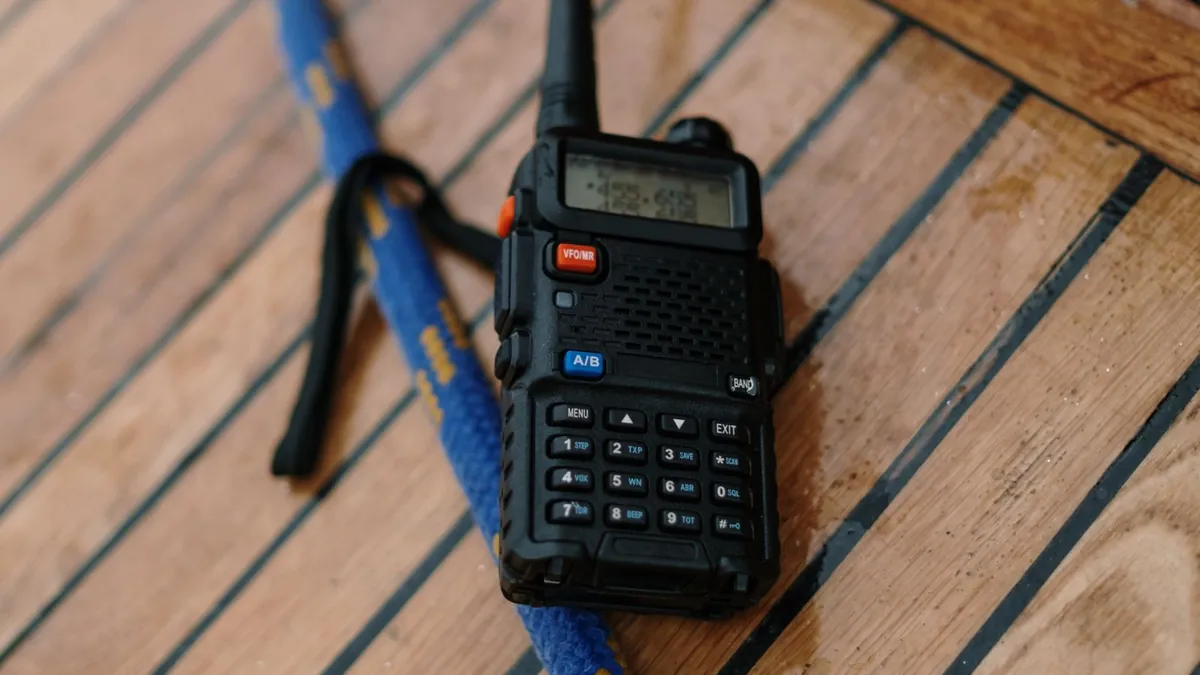
The Baofeng UV-5R is a cheap dual-band handheld that transmits on the 2 meter (144 to 148 MHz) and 70 centimeter (420 to 450 MHz) amateur bands, and it is the radio most people in North Carolina end up holding when they first think about talking without cell service. It is a real ham radio, which means you need a Technician license to key up on it, and it is not a legal substitute for a GMRS or FRS walkie-talkie. If you already hold a license or plan to get one, buy the UV-5R with a proper FTDI programming cable, a Nagoya NA-771 antenna and the 3800 mAh battery, and it becomes a usable storm radio for very little money. For a radio you can hand to a spouse with no test, read our GMRS radio guide instead.
What the UV-5R actually is
The UV-5R is a 5 watt (4 watts on the spec table Baofeng publishes) FM handheld with two bands: VHF around 2 meters and UHF around 70 centimeters. Baofeng's own page lists 136 to 174 MHz and 400 to 520 MHz receive coverage, 128 memory channels, an 1800 mAh battery and a weight of 500 grams with the battery and antenna fitted. It also receives FM broadcast, a small bonus when the power is out. The stock antenna is poor and the menus are cryptic, but it works and spare parts are everywhere.
Several versions sell under the UV-5R name. The one linked below is locked to transmit only inside the US amateur segments (144 to 148 MHz and 420 to 450 MHz, per the listing), which is the version to point a beginner at, because it cannot wander onto a frequency you are not allowed to use.
Where the law lands
This is the part most listings skip. The UV-5R transmits on amateur frequencies, and under 47 CFR Part 97 you need an amateur license before you transmit. Section 97.5 says the station must be under the physical control of a person named in an amateur station license grant before it transmits on any amateur frequency. The entry-level license is Technician, which covers every amateur band above 30 MHz, including both bands this radio uses. There is no Morse code test; the ARRL notes the FCC dropped the code requirement in 2007. The Technician exam is 35 questions and the license runs 10 years. We walk through the whole process in our ham radio for beginners guide.
Listening needs no license. Baofeng's own product page says it plainly: no license to buy, no license to listen, a license to transmit. You can program NOAA weather and the local repeaters and scan them all day with no paperwork.
GMRS, FRS and MURS are off limits
The UV-5R's UHF range covers the 462 and 467 MHz GMRS and FRS channels, and the older unlocked versions will happily transmit there. Doing so is not legal. 47 CFR 95.335 says no person shall operate a transmitter in any Personal Radio Service unless it is a certified transmitter, and using one that is not certified voids the user's authority to operate. GMRS rules (Part 95 Subpart E, section 95.1761) require the radio itself to be certified for GMRS. The UV-5R has no Part 95 grant, so a GMRS license does not make it legal on GMRS channels. Same story for FRS (Subpart B) and MURS (Subpart J). For the family on one set of channels you want a certified GMRS radio; see GMRS vs FRS.
The 2018 FCC advisory
In September 2018 the FCC Enforcement Bureau issued Enforcement Advisory 2018-03 (DA 18-980) about cheap VHF/UHF handhelds. The short version: a radio that transmits only on amateur frequencies needs no FCC equipment certification, and a licensed ham may use it. A radio that can also transmit outside the amateur bands (the advisory specifically calls out 136 to 143 MHz, 400 to 419 MHz and 451 to 520 MHz) cannot be imported, advertised, sold or operated in the US without a certification grant. The FCC also reminded operators that an amateur license is still required even on the amateur-only versions. That advisory is why UV-5R listings now come locked to the amateur bands, and why we recommend that version.
What matters when you set one up
- Programming. Typing frequencies and tones on the keypad works but is slow, and repeater offsets are easy to get wrong. A USB cable and the free CHIRP software let you build a channel list on a computer in ten minutes.
- Antenna. The stock rubber duck is the single biggest handicap. A longer whip tuned for 144/430 MHz is the first upgrade.
- Battery. The stock 1800 mAh pack is fine for a day of listening. For a multi-day outage, a 3800 mAh pack with USB-C charging lets you top up from a power bank or a small solar panel.
- Repeaters. Radio to radio you get a mile or two in the Piedmont. Through a repeater on a hill you can cover a county. Look them up before the storm.
Baofeng UV-5R

The Radio
Baofeng UV-5R
- Transmits 144 to 148 and 420 to 450 MHz only, per the listing
- 4 W high, 1 W low, per Baofeng's spec table
- 128 channels
- 1800 mAh battery
The cheapest way for a licensed Technician to get on 2 meters and 70 centimeters.
Check price on AmazonSold by Sharkoo (third-party seller)
This is the base radio: dual band, dual watch, 128 channels and a desk charger in the box. The version linked here transmits only on 144 to 148 MHz and 420 to 450 MHz, per the listing, which keeps a new operator inside the amateur bands. It suits a licensed Technician who wants a cheap radio to leave in a go bag or glove box and a backup to a nicer handheld. It does badly near strong signals (they bleed through), the menu labels are terse, and the stock antenna wastes much of your 4 to 5 watts. It needs a programming cable, a better antenna and ideally the bigger battery. The listing is from a third-party seller, so check the seller before you buy.
BTECH PC03 FTDI programming cable
Programming
BTECH PC03 FTDI Programming Cable
- Genuine FTDI chip, no driver hunt
- Kenwood K1 two-pin plug
- Works with CHIRP on Windows, Mac and Linux, per the listing
The cable that makes CHIRP programming work the first time.
Check price on AmazonSold by BTECH Radios
Buy the genuine FTDI cable and skip the counterfeit-chip clones that ship with many bundles; the clones are the main reason people give up on programming a Baofeng. The PC03 uses the two-pin Kenwood K1 plug found on Baofeng, BTECH, Retevis and similar radios, needs no old drivers on Windows, Mac or Linux, and works with CHIRP and the maker's own software. BTECH is the US distributor for Baofeng and sells it directly on Amazon. There is also a USB-C version if your laptop has no USB-A port.
CHIRP is free and open source, supports the UV-5R and most of its relatives, and imports repeater lists. Back up the factory image before you change anything.
Nagoya NA-771 antenna
Antenna Upgrade
Nagoya NA-771
- 15.6 inch flexible whip
- SMA-female connector
- Tuned for 144/430 MHz
- Up to 3 dBi gain, per the listing
The first upgrade every UV-5R owner makes.
Check price on AmazonSold by BTECH Radios
The NA-771 is a 15.6 inch flexible whip with an SMA-female connector that screws straight onto a UV-5R. It is tuned for 144/430 MHz and the listing claims up to 3 dBi of gain over the stock antenna, which in practice means you open repeaters you could only hear before. It is long enough to be awkward on a belt. Buy from BTECH's listing; fakes with the same name are common.
BTECH BL-5L 3800 mAh battery
Extended Battery
BTECH BL-5L 3800 mAh Battery
- 3800 mAh, double the stock pack
- USB-C charging on the pack, per the listing
- Fits UV-5R, BF-F8HP and other BL-5 radios
- Adds about 1.5 in and 3 oz
For multi-day outages and charging from a power bank.
Check price on AmazonSold by BTECH Radios
The BL-5L doubles the capacity of the stock pack and the current version charges over USB-C as well as in the desk cradle, per the listing. The USB-C port matters more than the capacity in an outage, because the same power bank that charges your phone refills it. It adds about 1.5 inches and 3 ounces per the listing. It fits the UV-5R, the BF-F8HP and anything else on the BL-5 battery standard.
Baofeng UV-5RM, the newer 10 watt version
Newer Version
Baofeng UV-5RM
- 10 W high power, per the listing
- 2500 mAh battery with USB-C
- 999 channels, NOAA weather, air band receive
- Ships with a 15 inch 771-style antenna
The refreshed UV-5R for someone buying their first one today.
Check price on AmazonSold by TIDRADIO Direct (third-party seller)
The UV-5RM is the current refresh of the same idea: 10 watts on high, a color screen, 999 channels, NOAA weather, an air band receiver and a 2500 mAh battery with USB-C on the pack, per the listing. It ships with a 771-style antenna in the box so you can skip that purchase. The keypad still programs the same way and CHIRP supports it. The extra power does less than people expect, but the battery, screen and included antenna make it the better buy for someone starting fresh. Its listing shows a wider transmit range than the amateur bands, so you are responsible for staying inside your privileges.
Baofeng BF-F8HP PRO, the one with readable menus
Readable Menus
BTECH BF-F8HP PRO
- Tri-band amateur transmit: 2 m, 1.25 m, 70 cm
- 1,000 memories in 10 named zones, per the listing
- Airband and NOAA receive
- USB-C charging, updatable firmware
A Baofeng with menus in plain English, for people who gave up on the UV-5R's.
Check price on AmazonSold by BTECH Radios
BTECH's BF-F8HP PRO is the Baofeng we would hand to someone who hates the UV-5R's menus. It has clear English menu text, 1,000 memories in named zones, tri-band amateur transmit (2 meters, 1.25 meters and 70 centimeters), air band and NOAA receive, USB-C charging and updatable firmware, per the listing. It keeps the same K1 accessory plug, so the PC03 cable and NA-771 antenna carry over. The listing itself says a valid amateur authorization is required to transmit, which is more honest than most. It does nothing on digital modes and costs noticeably more than a UV-5R.
The non-Baofeng alternatives
If you can spend more, the Yaesu FT-4XR and FT-65R are the usual next step. Yaesu lists both at 5, 2.5 or 0.5 watts, the FT-4XR with a 1750 mAh pack and the FT-65R with a 1950 mAh pack and a 3 year warranty. Their receivers are cleaner and the menus make sense. The FT-4XR had no Amazon listing when we checked and the FT-65R was in short supply, so neither is linked here; a dealer like Ham Radio Outlet will have them. The off-grid comms category covers the mesh radios that need no license at all.
| Item | What it does | Key figure | Best for |
|---|---|---|---|
| Baofeng UV-5R | Dual-band ham handheld | 144 to 148 and 420 to 450 MHz, 1800 mAh | Cheap first radio or spare |
| BTECH PC03 cable | Programming via CHIRP | Genuine FTDI chip, K1 plug | Anyone programming a Baofeng |
| Nagoya NA-771 | Replacement antenna | 15.6 in, SMA-female, 144/430 MHz | First upgrade |
| BTECH BL-5L | Extended battery | 3800 mAh, USB-C | Multi-day outages |
| Baofeng UV-5RM | Newer 10 W handheld | 2500 mAh USB-C, 999 channels | Starting fresh today |
| Baofeng BF-F8HP PRO | Tri-band with real menus | 1,000 memories, USB-C | Hates the UV-5R menu |
Who should not buy a UV-5R
Anyone who is not going to get the Technician license; a ham radio you cannot legally key is a scanner with extra steps, and a certified GMRS handheld does more for an unlicensed family. Anyone who expects the stock antenna and battery to carry them through a week without power. And anyone buying a 2 pack to split with an unlicensed neighbor, because the second person is the one the FCC advisory is about.
Questions people ask about the UV-5R
Do I need a license to own a Baofeng UV-5R?
No. You need an amateur license to transmit on it. Owning it and listening are fine, and Baofeng's own product page says exactly that.
Can I use a UV-5R on GMRS channels if I buy a GMRS license?
No. GMRS radios must be certified under Part 95, and 47 CFR 95.335 voids your authority to operate if the transmitter is not certified. A GMRS license covers you on a GMRS-certified radio, not on a UV-5R.
Is the Baofeng UV-5R illegal after the 2018 FCC advisory?
Owning one is not illegal. The advisory says radios that transmit outside the amateur bands cannot be sold or operated without certification, and that even amateur-only radios require an amateur license to transmit. Versions locked to 144 to 148 and 420 to 450 MHz fall inside the amateur exception.
How far will a UV-5R reach?
Radio to radio, a mile or two on flat ground with the stock antenna. Through a repeater it can cover a county. Antenna and terrain matter far more than the 5 watts.
What software programs the UV-5R?
CHIRP, which is free, plus a cable with a genuine FTDI or similar chip. Baofeng's own software also works but is Windows only.
The short version
Get your Technician license, then buy the amateur-locked UV-5R or the UV-5RM, the BTECH PC03 cable, the Nagoya NA-771 and the BL-5L battery, and program the local repeaters with CHIRP before the next storm.
Sources
- Baofeng UV-5R product page
- 47 CFR 97.5, station license required (eCFR)
- 47 CFR 97.301, authorized frequency bands (eCFR)
- 47 CFR 95.335, operation of non-certified transmitters prohibited (eCFR)
- 47 CFR Part 95 Subpart E, GMRS (eCFR)
- FCC Enforcement Advisory 2018-03, DA 18-980, two-way VHF/UHF radios
- ARRL, ham radio licenses
- CHIRP project wiki
Ready to buy?
See current models and availability on Amazon. Your clicks keep these guides free.
Shop Baofeng UV-5R Radios on Amazon →