How to Store Water Long Term at Home: Amounts, Containers, Treatment and Rotation
The CDC and Ready.gov method, with the containers and the preserver that make it work in a real house.
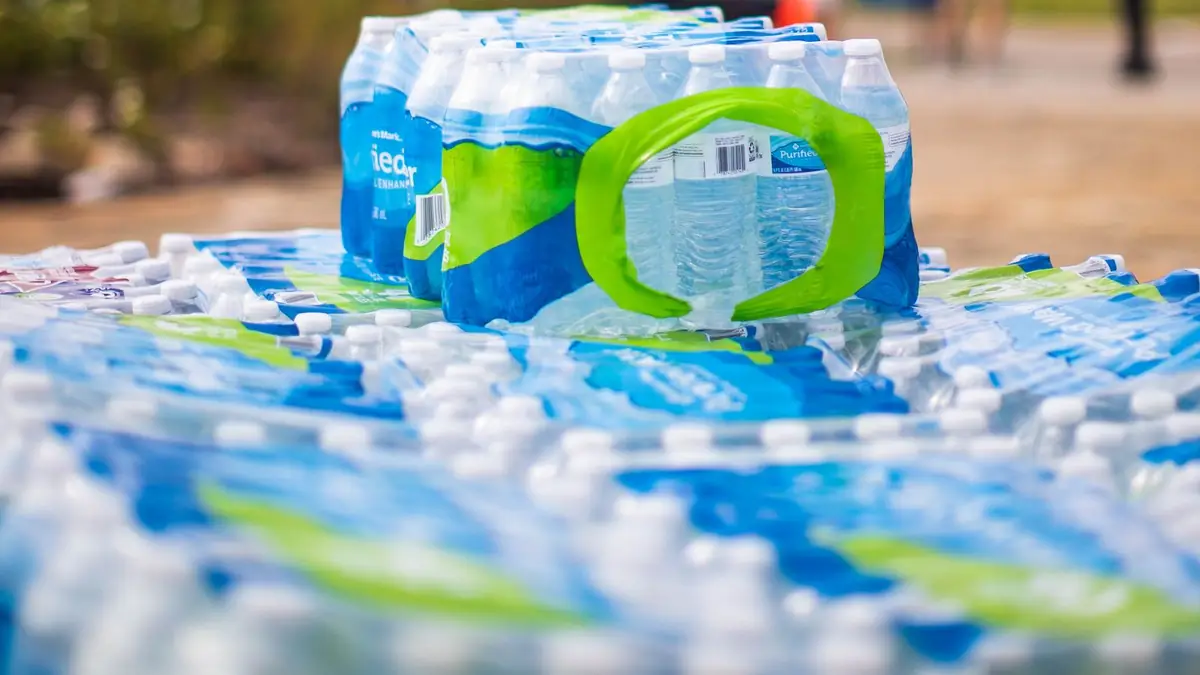
Store one gallon per person per day, for at least three days and ideally two weeks, in food-grade containers you cleaned with a bleach solution, filled from the tap, labeled with the date, and parked somewhere cool and dark. Replace the water every six months, or treat it with a water preserver, which its maker says keeps water for five years. That is the whole method, and it comes from Ready.gov, the CDC, and NC Emergency Management, all of which say the same thing in slightly different words. The rest is the detail: the math, the containers, cleaning and filling, getting water back out, and the mistakes that ruin a supply.
How much water to store
Ready.gov says to "store at least one gallon of water per person per day for several days, for drinking and sanitation." The CDC's emergency water supply page says at least one gallon per person per day for three days, with a two week supply preferred. NC Emergency Management's kit list for hurricane season says one gallon per person per day for three to seven days, and to include water for pets.
For a family of four:
- Three days: 12 gallons.
- One week: 28 gallons. Six 5 gallon jugs, or eight WaterBricks.
- Two weeks: 56 gallons. One 55 gallon tank, or a bathtub bladder plus jugs.
Ready.gov and the CDC both say to store more for children, nursing mothers, anyone sick, and in hot weather, when "water needs can double." An August outage in Charlotte with no air conditioning is that case. The gallon figure covers drinking and basic washing; flushing toilets and real bathing come out of the bathtub, the pool, or a rain barrel, not the drinking supply.
The containers themselves are compared in our best emergency water storage containers guide. Below are the two we would build a long-term supply around, plus a preserver and a spigot.
Containers that work for years
The CDC says to use FDA-approved food-grade containers with a tight-closing lid, made of unbreakable material (not glass), and to never reuse a container that held bleach, pesticide or other toxic chemicals. Food-grade HDPE in an opaque color is the standard, because it does not leach, it blocks the light that grows algae, and it survives being dropped.
Emergency Water Tanks 55 Gallon Stackable Tank

Two Weeks for Four
Emergency Water Tanks 55 Gallon Stackable Tank
- 55 gal, stackable
- 27.75 x 21.75 x 29.5 in
- 22 lb empty, 490 lb full
- 5 in threaded vented lid
- 3/4 in GHT lead-free brass spigot
For the one tank that holds the CDC's preferred two week supply for a family of four.
Check price on AmazonSold by Hive Innovations
A 55 gallon stackable tank is the simplest way to hold two weeks for four people. The Emergency Water Tanks brand is a division of Hive Plastics in Cedar City, Utah, and the Amazon seller is Hive Innovations. The maker's page lists 27.75 by 21.75 by 29.5 inches, 22 pounds empty and 490 pounds full, a 5 inch threaded vented lid, and one 3/4 inch GHT lead-free brass spigot. The 5 inch lid matters because every few years you will want an arm in there to scrub it. Fill it in place; it is not moving again.
WaterBrick 3.5 Gallon Containers (4 pack)
Easy to Rotate
WaterBrick 3.5 Gallon Containers (4 pack)
- 4 x 3.5 gal (14 gal)
- 9 x 18 x 6 in each
- 2.52 lb empty, about 27 lb full
- 3.25 in lid opening
- HDPE, BPA-free, cross-stacks
For a supply you rotate a few gallons at a time and store under a bed.
Check price on AmazonSold by WaterBrick International
For a supply you can rotate through the kitchen a few gallons at a time, WaterBricks are the easiest to live with. WaterBrick's spec page lists each brick at 9 by 18 by 6 inches, 3.5 gallons, 2.52 pounds empty and about 27 pounds full, HDPE with a polypropylene lid and a TPE gasket, with a 3.25 inch lid opening an adult can reach a hand through. A 4-pack (14 gallons) cross-stacks under a bed. Sold by WaterBrick International. Buy the spigot below with them.
Clean the container before the first fill
The CDC's cleaning procedure, which we follow exactly:
- Wash the container with dish soap and rinse it thoroughly.
- Mix one teaspoon of unscented liquid household bleach (5 to 9 percent sodium hypochlorite) into one quart of water.
- Pour it in, cap tightly, and shake so the solution reaches every inside surface.
- Wait at least 30 seconds, then pour it out.
- Let the container air dry, then fill it with clean water and seal it.
Ready.gov gives the same teaspoon-per-quart mix. Use plain bleach: not scented, not color-safe, not "splashless," and nothing with added cleaners. For a 55 gallon tank you cannot shake, mix a few quarts of solution, pour it in, roll the tank on its side across the floor, let it sit, drain through the spigot, and rinse.
Fill it, treat it, label it
Municipal tap water in North Carolina is already chlorinated, and the CDC says to fill clean containers with clean water and seal them; no further treatment is needed for a six month rotation. Well water is not chlorinated, so treat it. Ready.gov's dose for disinfecting water with 5.25 to 6 percent bleach is 1/8 teaspoon per gallon, stirred and left for 30 minutes, with a faint bleach smell at the end. Let cloudy water settle or strain it through a coffee filter first. No chlorine smell after 30 minutes means repeat the dose once; still nothing, and Ready.gov says to discard it.
Write the fill date on the container with a paint marker and the words "drinking water," which is the CDC's instruction and the one everybody skips. In two years you will not remember which jug is which.
Water Preserver Concentrate (55 gallon bottle)
Five-Year Treatment
Water Preserver Concentrate (55 gallon bottle)
- One bottle treats 55 gal
- 5-year storage, guaranteed per the maker
- 10 years of laboratory testing, per the maker
- Made by 7C's Safety and Environmental
For a tank you want to fill once and not drain every six months.
Check price on AmazonSold by Green Goods Products (third-party reseller)
If you do not want to drain and refill a 55 gallon tank every six months, a water preserver is the alternative. The original is Water Preserver Concentrate from 7C's Safety and Environmental in Huntington Beach, California, whose site says one bottle treats 55 gallons and keeps it safe and drinkable for five years, guaranteed, with ten years of laboratory testing behind the claim. The maker's site gives no dosing instructions, so follow the label that comes in the box. The five year figure is the maker's claim. The in-stock Amazon seller is Green Goods Products, a third-party reseller. You still write the date on the tank. Pure Flow Lab, our sister site, covers purification tablets and filters for water that was not clean to begin with at pureflowlab.com; a preserver is for keeping clean water clean, not for making bad water safe.
Where to keep it
The CDC's storage conditions are 50 to 70 degrees, out of direct sunlight, and away from toxic substances, which in a Carolina garage means the gas can and the pesticides. That describes an interior closet, a laundry room, a basement wall, or under a bed. It does not describe a Carolina garage in July, which runs well past 90 degrees and usually has a gas can in it. If the garage is the only option, keep the tank away from the mower, off the concrete on boards, and rotate it on schedule.
Getting the water back out
A tank with a low spigot drains by gravity, but the spigot sits a few inches off the floor, so keep a short length of garden hose or a shallow pan with it. A round drum with two bung holes on top has no way to get water out except a hand pump or a siphon, and the time to find that out is not during an ice storm. WaterBricks and 5 gallon jugs take a screw-on spigot, or you tip and pour. The CDC adds one rule: use a clean scoop or spigot every time, and never put hands into the water or the container.
WaterBrick Spigot Attachment
Spigot Lid
WaterBrick Spigot Attachment
- 3/4 in inlet
- LDPE
- Ventless, no second hole needed
- 0.25 lb
- Fits both WaterBrick container sizes
For pouring from a WaterBrick without tipping 27 pounds over a glass.
Check price on AmazonSold by WaterBrick International
WaterBrick's ventless spigot assembly is a blue spigot with a 3/4 inch inlet, made of LDPE and weighing 0.25 pounds, and it fits both WaterBrick container sizes. Ventless means the brick does not need a second hole to breathe. One spigot serves the whole stack: you move it to whichever brick is open. Sold by WaterBrick International.
The bathtub, and when to fill it
NC Emergency Management's hurricane page says to "fill the bathtub and other larger containers with water" before a storm, and to keep a supply for sanitary uses like cleaning and flushing toilets. An open tub is for flushing and washing, not drinking; it has soap film in it.
A bathtub liner changes that: a sealed food-grade bladder you lay in the tub, fill from the faucet, and pump from with a manual pump. Check the maker's food-grade statement before you buy one. Fill it the night before landfall, or before an ice storm when the forecast is firm, while the pressure is still on. The tub is out of service until you pump it dry.
The CDC also lists "water from your home's tap water heater tank" as an emergency source, meaning the tank that feeds your faucets and not the one that feeds old radiators. Shut off the power or gas and the cold inlet first, then drain from the bottom valve.
Rotate it
Ready.gov and the CDC both say to replace self-filled water every six months. Tie it to something you already do: the first of June when hurricane season starts and the first of December when it ends. Old water goes on the garden. Rinse, refill, and write the new date over the old one. A tank on a preserver follows the maker's interval instead, but open the lid once a year to look and smell.
What not to use
- Milk jugs. The thin plastic is made to last weeks, the caps do not seal, and milk residue feeds bacteria.
- Anything that held chemicals. Bleach bottles, pesticide containers, detergent jugs. The CDC's rule, no exceptions.
- Glass. The CDC says unbreakable material only. Carboys break when a shelf lets go in a storm.
- Clear containers in the sun. Light grows algae. If the only container is clear, keep it in a closet.
- Scented or "splashless" bleach for treating. Ready.gov says regular household bleach with sodium hypochlorite as the only active ingredient.
Questions people ask about long-term water storage
Does stored water go bad?
Water itself does not spoil, but anything living in it or in the container grows over time, and plastic can give it a taste. That is why the CDC and Ready.gov say six months for self-filled water.
Do I have to treat tap water before storing it?
City water is already chlorinated, so clean container plus clean tap water plus a six month rotation needs nothing added. Treat well water, and treat any water you want to keep longer than six months.
Can I drink water that has been stored a year?
The agencies' guidance is six months. When in doubt, boil it at a rolling boil for one full minute before drinking, and pour it between two clean containers to fix the flat taste.
The short version
Clean a food-grade container with a teaspoon of bleach in a quart of water, fill it from the tap, date it, keep it cool and dark, and refill it every six months. Store a gallon a day for everyone in the house for as long as you can find room for, starting with three days and working toward two weeks. More storm gear is on the storm prep page, and the rest of the storm box is in our North Carolina hurricane kit.
Sources
- Ready.gov: Water
- CDC: How to Create and Store an Emergency Water Supply
- Emergency Water Tanks 55 gallon tank (Hive Plastics)
- CDC: How to Find Clean Water in an Emergency
- NC Emergency Management (ReadyNC): Get a Kit
- NC Emergency Management (ReadyNC): Hurricanes
- WaterBrick product specifications
- Water Preserver Concentrate (7C's Safety and Environmental)
- WaterBrick ventless spigot assembly
Ready to buy?
See current models and availability on Amazon. Your clicks keep these guides free.
Shop Water Storage on Amazon →